When antimatter meets matter, the two annihilate. Complete destruction. All of their mass turns into energy. A gram of antiprotons meeting a gram of protons would release the energy of three Hiroshima bombs.
Because our universe is mostly made up of matter, it’s easy to end up thinking of antimatter as inherently explosive. An exotic intruder the universe is trying to get rid of.
But that misses the point. An antiproton, in itself, is no more unstable than any proton in your body. The problem is the environment. It is an accident of the universe that there is so much more matter than antimatter. It could have been the other way around. On anti-Earth, the antiproton would sit as peacefully as the proton does here. The proton would be the danger.
If you want to use antimatter, the challenge is engineering the conditions in which it can be stable. For three decades after antiprotons were discovered in 1955, no one solved this. You could make antiprotons. You could watch them annihilate. You could not hold on to one. Then in 1986, a team from the University of Washington caught the first antiprotons in a magnetic trap. Antimatter became something you could possess and use.
This is a recipe for creating usable antimatter. Seven steps to make it, catch it, and carry it to wherever you want to use it.
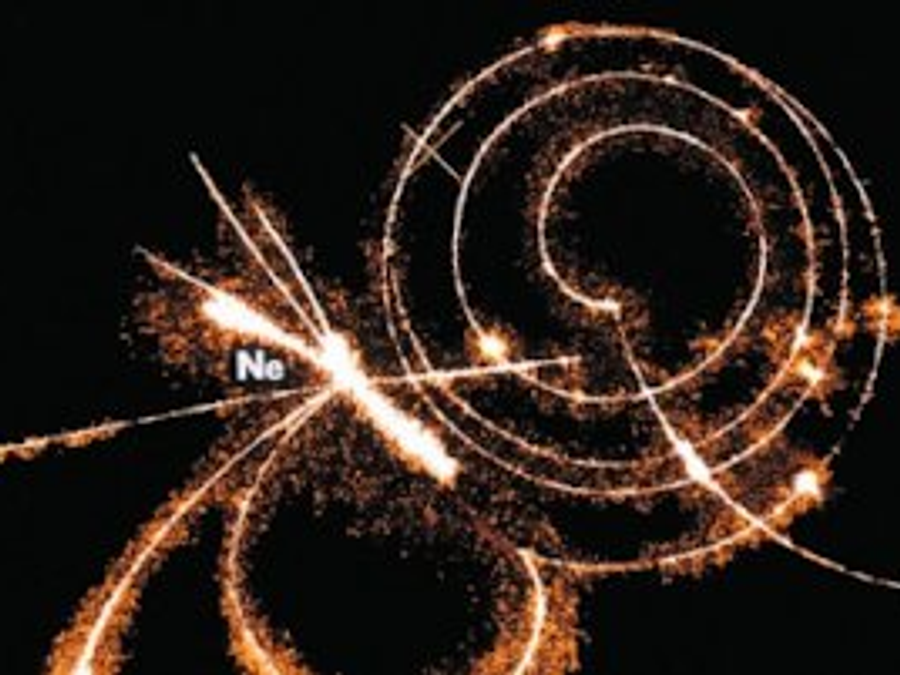
Image in the header - Annihilation An antiproton collides with an atom of gaseous neon in the PS-179 experiment at CERN’s Low-Energy Antiproton Ring in 1984. Credit: CERN
Step 1: Produce antiprotons
Take a beam of protons accelerated to almost the speed of light, and fire it at a “high-Z” material (a heavy element, dense with protons). The collision creates a shower of secondary particles. A small fraction are antiprotons. You’re at the races.
CERN’s high-Z material of choice is iridium. Why iridium? Because antiprotons emerge in all directions from the point where the proton beam hits, and the equipment downstream can only catch them efficiently if that point is small. Iridium is the second-densest metal on Earth (after osmium and before platinum). A short, thin rod packs enough nuclei to produce a useful number of antiprotons while keeping the source compact. Other metals work too, but iridium gives the best yield per square millimetre.
Step 2: Catch and select them
Now you want to catch the antiprotons.
Immediately downstream of the target, place a “magnetic horn”. This is a powerful, conical electromagnet that pulls the divergent antiprotons into a roughly parallel beam, like sunlight gathered by a lens.
The beam this gives you is a bit of a mess. The antiprotons in it are moving with a wide range of momenta, and only a narrow band is useful. So past the horn, place a series of bending magnets. The magnetic field deflects a charged particle's path, and the amount of deflection depends on the particle's momentum. Tune the magnets so that only the desired antiprotons curve onto the correct path. The rest miss the next aperture and are lost.
What comes out the other end is a clean beam of antiprotons moving at around 97 per cent of the speed of light.
Step 3: Slow them down
A relativistic antiproton would punch straight through any container you tried to hold it in. So before you can trap one, you need to bleed almost all of its energy.
To do that, you send the beam into a series of decelerator rings. Each ring is a vacuum pipe bent into a closed loop, with magnets to keep the antiprotons curving round it. On every lap, the antiprotons pass through a region of oscillating electric field, tuned to push back against their direction of travel. Each pass shaves off a tiny amount of speed. Over millions of laps, the speed comes down.
But there's a problem. Slowing the beam makes it spread out.
Antiprotons all carry the same negative charge, so they naturally repel each other. But a beam of moving charged particles is also an electric current, and electric currents create magnetic fields. Parallel currents attract.
At low speeds, that magnetic attraction is tiny compared to the electrical repulsion. But as the antiprotons approach the speed of light, relativity changes the balance. The magnetic attraction grows strong enough to cancel most of the beam’s tendency to blow itself apart.
The really strange part is that this depends on your frame of reference.
In the beam’s own rest frame, the antiprotons are barely moving relative to each other. There’s almost no magnetic effect at all — just ordinary electrical repulsion. But from the laboratory frame, the whole beam is racing forward near light speed, so it behaves like a huge current and generates a strong magnetic field.
Both views are correct. Special relativity ties them together. What looks like “just electricity” in one frame partly turns into magnetism in another. Time dilation and length contraction are part of what makes the two descriptions agree.
Slow the beam down and the magnetic effect weakens. The electrical repulsion doesn’t. The antiprotons stop moving in perfect lockstep. Some drift a little faster, some a little slower, and the beam starts to spread out until particles hit the walls and are lost.
So as you decelerate, you also need to cool. Cooling here doesn't mean lowering temperature in the everyday sense. It means narrowing the spread of speeds, pulling the strays back toward the average. There are two ways to do this. In the first, sensors around the ring detect when small groups of antiprotons deviate from the mean orbit, and on the opposite side of the ring a set of electrodes nudges them back into line. In the second, the antiprotons are flown alongside a beam of cold electrons, and through countless tiny electromagnetic interactions the electrons absorb the antiprotons' velocity spread.
By the time the antiprotons leave the final ring, they’re moving at less than 1.5 per cent of the speed of light, in a tight bunch ready to be caught in a trap.

Step 4: Store them
Now you store your antiprotons in a device called a Penning trap. A magnetic field stops them escaping sideways. An electric field stops them escaping along the ends.
The antiprotons end up sitting in a tiny region in the centre of the trap. If the antiprotons touch anything — a stray molecule of gas, the trap wall — they annihilate. So the trap is sealed, the air pumped out, and the whole thing cooled to near absolute zero. Any stray gas molecules left inside freeze to the cold metal walls and stay there. What's left in the middle is a vacuum better than the vacuum of interstellar space. In a good laboratory vacuum, antiprotons would annihilate within a second. In this one, they last over a year.
The limits of storing bare antiprotons
Physics imposes a limit on the number of bare antiprotons you can store in a Penning trap.
The antiprotons don't want to sit still together. Because they all carry the same negative charge, they push each other apart. The more you pack into the trap, the harder they push.
The magnetic field is what holds them in against this push. A stronger field holds them more tightly. But every magnet has a ceiling. The wire that carries the current is superconducting, and superconductors lose their superconductivity above a certain field strength. Push the field too high and the magnet quenches.
The limit for a Penning trap is about 10¹² antiprotons. That’s comfortably enough for the amount of antiprotons required for cancer therapy and fundamental physics experiments.
But for the most ambitious applications of antiprotons, you need far more antiprotons than can be stored in this trap. Using them for rocket propulsion through antimatter-catalysed fusion? A Mars mission needs about 10¹⁷. That's five orders of magnitude above the Penning trap’s limit. You're not putting one hundred thousand Penning traps on a spacecraft.

Step 5: Combine antiprotons with positrons
The fix to the charge problem is to cancel it out. You mix your trapped antiprotons with a cloud of positrons. If a positron settles into orbit around an antiproton, you have an atom: an antiproton at the centre, a positron orbiting it. This is antihydrogen. It carries no net charge, so the particles don't push each other apart, and you can pack far more of them into the same volume.
The easy part is sourcing positrons. They fall out of certain radioactive isotopes as they decay. A pellet of sodium-22 the size of a fingernail will give you millions per second.
The hard part is actually combining them with antiprotons. Even in a dense positron cloud, most antiprotons sail straight through and come out the other side unchanged. For capture to happen, one positron has to fall into orbit around the antiproton, and at the same instant a second positron has to be there to carry off the excess energy. Without the second positron, the first can't shed enough speed to stay bound. Two positrons hitting the same antiproton at the same moment is a rare coincidence. Cranking up the density of the positron cloud raises the odds, but only so far.
Step 6: Trap the antihydrogen
Antihydrogen is neutral, so the Penning trap's fields no longer grip it. The moment an atom forms, it drifts off and annihilates against the apparatus within microseconds.
The fix is that although antihydrogen carries no net charge, it behaves as a tiny magnet. This property can be exploited to use a magnetic field to confine the antihydrogen so that it falls toward the middle and sits there.
The Penning trap's field won't do. It's designed to hold the charged antiprotons. It won’t be able to contain the antihydrogen and prevent it from annihilating with the chamber walls.
So add a second set of magnets to the same apparatus, arranged to produce the field you need. This new field occupies the same vacuum as the Penning trap's existing fields; fields aren't physical objects, and one can sit on top of another in the same region of space. The antihydrogen settles in the middle and stays there.
This is doable, but only just. The trap is shallow and it can only hold antihydrogen moving slower than about 90 metres per second. That’s about twice the speed of an MLB fastball. Anything faster flies straight out.

Step 7: Transport
Whether you’re using bare antiprotons or antihydrogen, you’ll often want to take your antimatter on the road. For a Mars mission, you need to move your antihydrogen from the production facility to the spacecraft. For medical use, you need to move your bare antiprotons to a hospital. The trap has to travel.
This is hard. Every condition that lets the trap work — the vacuum, the superconducting magnets, the uniform field — is built on the assumption that the trap sits still in a temperature-controlled room with a constant power supply. Take it on the road and all of that breaks.
The magnets have to stay below their critical temperature the whole way. In the lab, that's done with a continuous supply of liquid helium from a building-scale cryogenic plant. In transit, you need a self-contained cooling system running on its own power for hours or days, surviving vibration, road bumps, and temperature swings. If the magnets warm above their critical temperature even briefly, they quench, the field collapses, and the antimatter is lost.
The vacuum has to hold. Any seal failure, like a vibration loosening a connection or a thermal gradient cracking a weld, lets gas molecules in. The antimatter goes from lasting a year to annihilating in seconds.
No Secret Ingredients
That is the recipe. Seven steps. Each one an engineering problem in its own right. Well understood but leaks at every step.
For every billion antiprotons that come off the iridium target, fewer than ten end up trapped as antihydrogen. This is almost exactly as if Guinness ran its entire global brewing operations to serve ten pints a year. It’s sacrilegious.
The rest are lost on the way. Scattered off the target at the wrong angle. Filtered out at the wrong momentum. Annihilated against stray gas in an imperfect vacuum. Missed by a positron at the moment of recombination. Punched through the shallow walls of the magnetic trap. The pipeline works. It does not work efficiently.
None of this is mysterious. Every loss in the funnel is a known problem with a known set of candidate fixes. Better targets. Better collectors. Better cooling. Denser positron clouds. Deeper magnetic wells. Some are being actively worked on. Some are not.
The gap between what we produce today and what the most ambitious applications need is many orders of magnitude. But it is a gap made of engineering problems, not physics ones. And, in the long term, that means it can be bridged with capital and intelligence.